
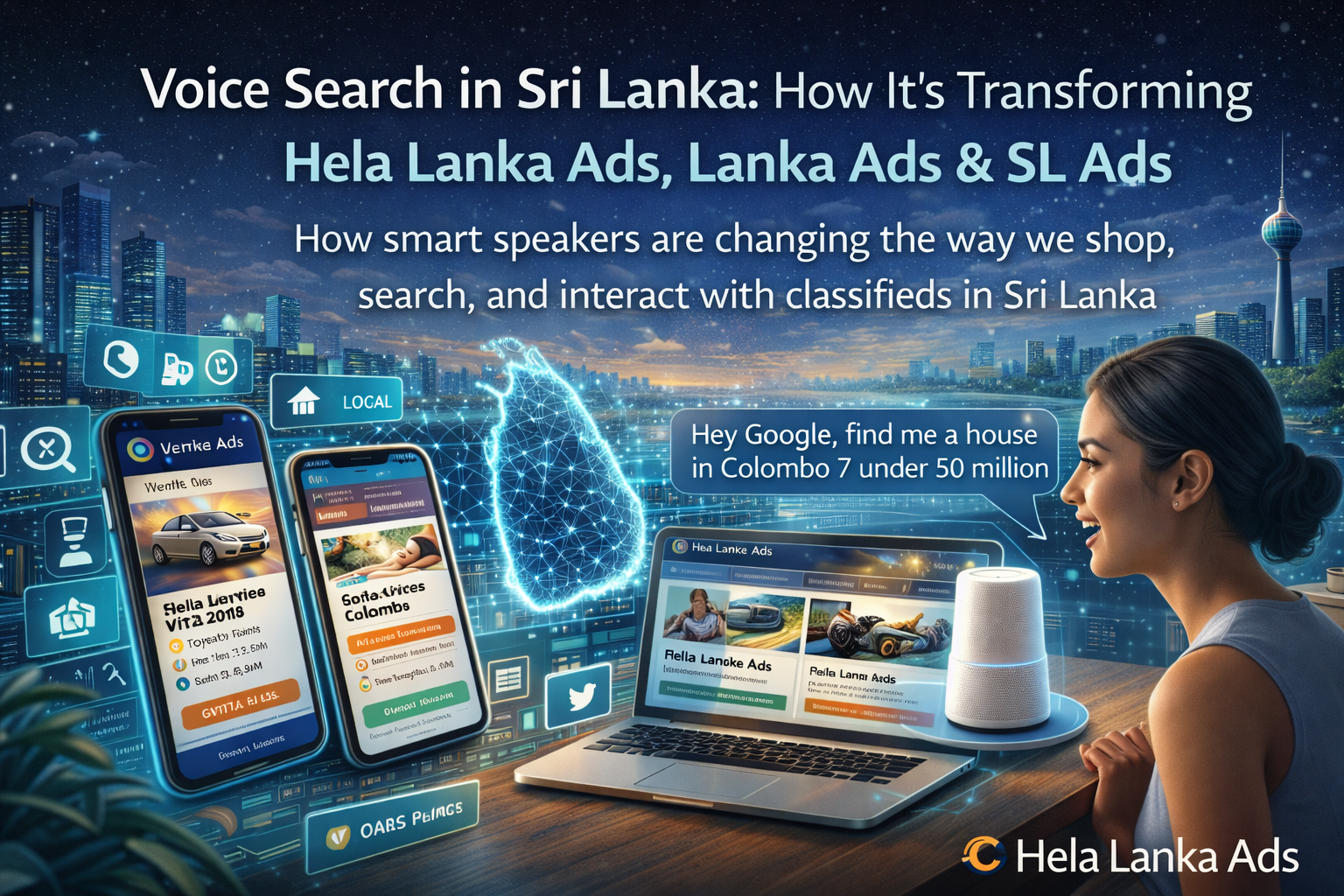



Voice Search in Sri Lanka: How It's Transforming Hela Lanka Ads, Lanka Ads & SL Ads
How smart speakers are changing the way we shop, search, and interact with platforms like Hela Ads
Science fiction? Not anymore. It's happening right now in thousands of Sri Lankan homes.
Smart speakers—those cylindrical gadgets from Amazon, Google, and Apple—are quietly transforming how urban Sri Lankans interact with technology. And if you're selling anything on Hela Ads or browsing classifieds, this shift is going to change everything about how people find your listings.
Let me show you what's actually happening, why it matters, and what you should do about it.
The Numbers Nobody's Talking About
Here's the reality in 2026:
That might not sound impressive. It's not. Compare it to the US (30% penetration) or the UK (25%), and Sri Lanka is way behind.
But here's what makes it interesting: that 3.9% is projected to hit 6.3% by 2029. That's a 62% increase in just four years.
More importantly, look at WHO is adopting these devices:
- Age 25-34: The core demographic. Tech-savvy, earning decent income, active on platforms like Lanka Ads
- Urban households: Colombo leads with 10-15% penetration in specific neighborhoods
- Middle-class families: The same people shopping and selling on classified platforms
With 56.3% of Sri Lanka's 22 million people online (12.34 million internet users), that puts the current smart speaker market at roughly 200,000-300,000 urban households.
That's not massive. But it's not negligible either. And it's growing.
What People Are Actually Using Them For
Let me bust a myth: these aren't just fancy Bluetooth speakers.
Sri Lankan users—especially in Colombo—are using smart speakers for:
Top Use Cases
- Music and entertainment: Spotify, YouTube, local radio (most common use)
- Smart home control: Lights, AC, fans (increasingly popular as devices get cheaper)
- Voice search: Weather, news, general queries
- Security integration: CCTV monitoring, door locks
- Shopping and deals: This is where it gets interesting for Hela Ads
Here's the kicker: voice search behavior is fundamentally different from typing.
When you type, you might search: "apartment colombo 7"
When you speak, you say: "Hey Google, find me a three-bedroom apartment in Colombo 7 under 50 million rupees"
Notice the difference? Voice searches are longer, more conversational, more specific. This changes EVERYTHING about how listings should be optimized on platforms like Lanka Ads.
The Brands That Are Winning
If you're curious about the actual devices Sri Lankans are buying:
- Google Nest & Amazon Echo: 40-50% market share. They integrate easily with local apps and services.
- Xiaomi Mi AI Speaker: Popular for budget-conscious buyers. Decent functionality at lower prices.
- Apple HomePod: 10-15% share, mostly wealthy urbanites who already use iPhones.
Price points matter enormously here:
- Under $100 (Rs 15,000): Entry-level, driving most adoption
- $100-$200 (Rs 15,000-30,000): Mid-range sweet spot
- Over $200: Premium tier, minimal uptake due to price sensitivity
E-commerce platforms like Daraz saw smart speaker sales spike 135% year-over-year from 2023 to 2024. That's not a slow burn—that's acceleration.
Local players like CLEVR and SLT-MOBITEL are bundling these with internet packages, making them more accessible. When you sign up for fiber internet, they throw in a Google Nest Mini. Smart distribution strategy.
The Roadblocks (And Why They Matter)
What's Holding Back Mass Adoption
1. Language support is pathetic
Most smart speakers still don't do Sinhala or Tamil well. Google Assistant has basic support, but it's clunky. For a country where many people aren't comfortable with English, this is a massive barrier.
2. Internet infrastructure outside cities is rough
Average mobile internet speed is around 20 Mbps. Smart speakers need consistent connectivity. When your connection drops every 10 minutes, voice assistants become frustrating instead of helpful.
3. Privacy concerns are real
Surveys show 30-40% of potential buyers worry about voice data privacy. "Is this thing listening to everything I say?" Trust issues slow adoption significantly.
4. Traditional Bluetooth speakers are cheaper
Why spend Rs 15,000 on a smart speaker when a regular Bluetooth speaker costs Rs 3,000? For most people, the smart features don't justify the price premium yet.
These challenges explain why smart speakers still represent only 5-7% of the overall speaker market in Sri Lanka.
But here's the thing: every single one of these barriers is solvable and actively being solved.
The Opportunity for Lanka Ads Sellers
How Voice Search Changes Classified Advertising
If you're selling on Hela Ads or any classified platform, here's what the voice search revolution means for you:
Optimize for natural language: Instead of keyword-stuffing "apartment Colombo cheap rent," write descriptions that sound like how people actually talk. "Three-bedroom apartment in Colombo 7, perfect for families, affordable rent with parking included."
Answer specific questions: People ask voice assistants questions. "What's the best used car under 4 million?" Make sure your listing answers common questions explicitly.
Location, location, location: Voice searches are heavily location-based. "Near me" searches are huge. Make sure your listings have precise location details.
Mobile-first is voice-first: With 56.3% internet penetration and most of it on mobile, voice search naturally follows mobile browsing habits.
Here's a concrete example:
Old-style listing title: "2019 Axio low km good condition"
Voice-optimized listing title: "2019 Toyota Axio, 32,000 km, excellent condition, Colombo, verified owner, Rs 3.85 million"
The second one answers multiple questions a voice searcher would ask. It's longer, more descriptive, and structured for how people actually speak.
What's Coming Next
By 2030, experts project 10-15% smart home penetration in Sri Lanka. Smart speakers specifically could pull in $5-7 million in annual revenue by 2029.
What's driving this growth?
- 5G rollout: Faster, more reliable connectivity solves one of the biggest pain points
- Price drops: As production scales globally, devices get cheaper. We're already seeing Rs 10,000 functional smart speakers.
- Local language support: Companies like Anscom are adding Sinhala and Tamil voice recognition. Game-changer when it improves.
- Government digital push: The Digital Economy Strategy encourages smart home adoption indirectly through infrastructure investment
- Bundling deals: Telecom providers bundling smart speakers with internet packages lowers the barrier to entry
The Smart Money Bet
Urban youth aged 25-34 who are already active on Hela Lanka Ads are the early adopters. They're comfortable with technology, they're buying and selling online, and they're the exact demographic embracing smart speakers.
If you're targeting this group with personal ads, spa services, professional services, or product listings, optimizing for voice search isn't future-proofing—it's capturing market share right now.
Your Action Plan
Okay, enough theory. Here's what to actually do:
- Audit your listings on Hela Ads — Are your titles and descriptions conversational? Would they make sense read aloud?
- Add natural language details — Instead of "3BR apt Col7," write "Three-bedroom apartment in Colombo 7 with parking"
- Answer common questions in your description — Think about what voice searchers would ask and answer it explicitly
- Focus on location specificity — "Near Cinnamon Gardens," "5 minutes from Bambalapitiya station," "Walking distance to Royal College"
- Test voice search yourself — Use Google Assistant or Alexa to search for items like yours. See what results come up. Learn from what works.
- Track the trend — Smart speaker adoption is growing 6.29% annually. The sellers who optimize now have a first-mover advantage.