
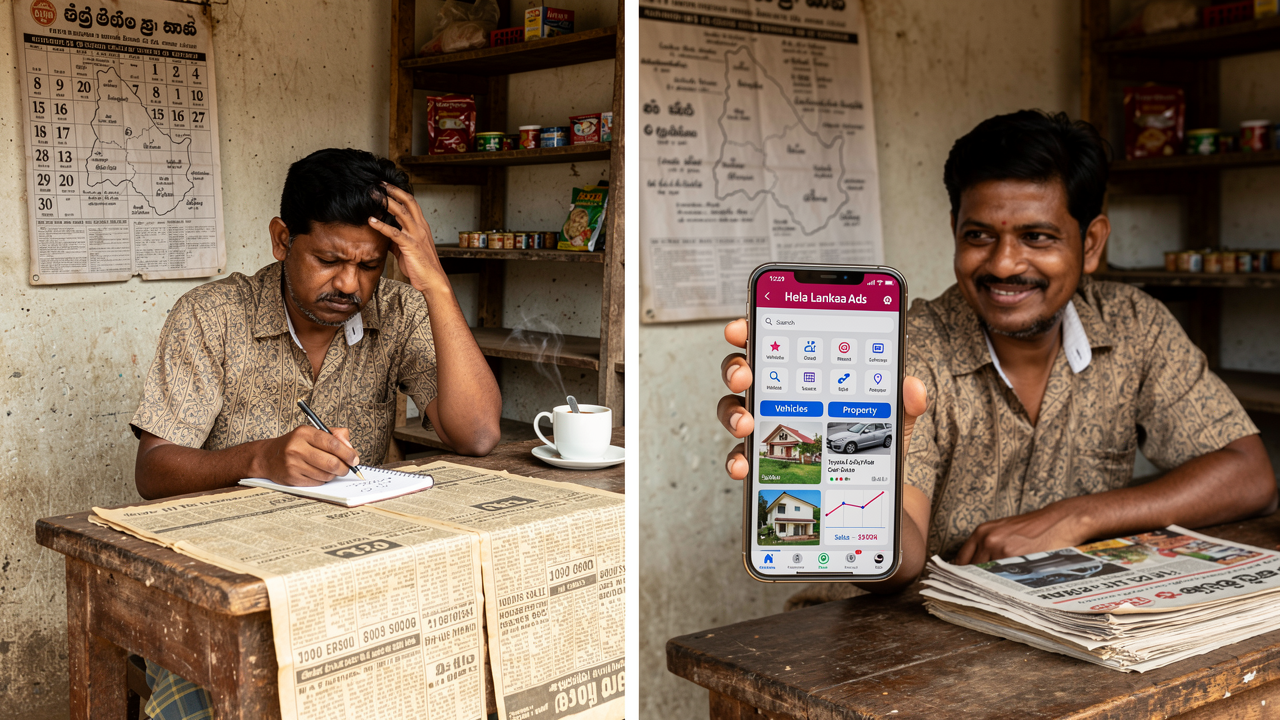



Here's something wild: the way you buy and sell stuff in Sri Lanka today has roots going back to 1737. That's before the French Revolution. Before America existed. Before trains were invented.
Dutch colonists set up the first printing press in what's now Sri Lanka, and without realizing it, they created a system that would shape commerce for nearly three centuries.
But here's the crazy part: despite having 12.34 million internet users today, 79% of marketing budgets still go to those old newspaper classifieds.
I know what you're thinking: "Who cares about history? I just want to sell my car."
Fair. But understanding this evolution explains why Lanka Ads platforms are exploding right now, and why businesses that adapt are seeing 75% sales growth while their competitors wonder what happened.
The Colonial Print Era (Or: How Newspapers Became King)
Let me paint you a picture of how this all started.
In 1737, Dutch colonists brought the first printing press to Sri Lanka. Initially, it was for religious texts—boring stuff. But by 1802, the Government Gazette was publishing the island's first official classifieds.
Fast forward to 1832: the Colombo Journal appears. Then in 1834, the Observer and Commercial Advertiser launches. These weren't just newspapers—they became the marketplace. The only marketplace.
📰 The Print Timeline That Built Sri Lanka's Commerce
By 1980, classified ads were generating 42% of all print revenue. Think about that—nearly half of newspaper income came from people trying to sell cars, find jobs, or rent apartments.
Colombo's classified sections would span 12 pages every week. Regional newspapers like Lankadeepa captured 67% of rural readership. This system supported about 15,000 small businesses across the country.
It was slow. It was expensive. But it was all we had.
If you wanted to sell a car, you'd spend LKR 5,000 on a newspaper ad, wait a week for it to run, hope someone saw it that specific day, and pray they called before the ad expired. Check today's vehicle listings to see how far we've come.
The Digital Awakening (When Everything Changed)
The late 1990s is when things got interesting.
In 1999, Topjobs.lk revolutionized recruitment in Sri Lanka. For the first time, you could search for jobs online. Sounds basic now, but it was mind-blowing then.
Internet penetration was only 2.3% nationally in 2000. Most people still had dial-up internet that made that horrible screeching sound. But the seed was planted.
📰 The Print Era
Cost per listing: LKR 5,000
Wait time: 7 days to publish
Duration: One day, then gone
Reach: Local area only
Response time: 72+ hours average
Edit capability: None—it's printed
💻 The Digital Era
Cost per listing: LKR 400
Wait time: Instant publish
Duration: 30+ days active
Reach: Nationwide instantly
Response time: 3.2 hours average
Edit capability: Unlimited updates
Between 2005 and 2010, platforms like Ikman.lk and Riyasewana launched. By 2012, they'd captured 34% of the classifieds market. The revolution had begun.
Smartphone adoption accelerated everything. In 2010, only 15% of people had smartphones. By 2015? 68%. And mobile data prices dropped by 73% during that same period.
Small businesses were saving LKR 15,000 monthly on advertising. That's real money for a small shop owner in Kurunegala or a vehicle dealer in Galle.
By 2015, digital platforms were processing 2.3 million listings annually. This shift created 45,000 new micro-entrepreneurs—people who could now start businesses without expensive print advertising. Learn more through our educational resources on digital transformation.
The Surprise: Estate Workers Are More Connected Than City Folks
Here's something that shocked me when I saw the data:
🤯 The Connectivity Paradox
Computer ownership by area:
- Urban households: 36.6%
- Rural areas: 16.8%
- Estate sectors: 1.5%
But smartphone internet adoption tells a different story:
- Estate workers: 91.4% 🏆
- Rural areas: 81.7%
- Urban residents: 73.8%
Yeah, you read that right. Estate workers have HIGHER smartphone adoption than city dwellers.
Why? Because they skipped computers entirely and went straight to mobile. They didn't need a LKR 50,000 laptop. They needed a LKR 15,000 smartphone with cheap data.
And here's what's really interesting: estate workers use an average of 4.3GB of mobile data per month—more than urban users (3.2GB) and rural users (2.1GB).
This mobile-first revolution is transforming access to professional services and opportunities across every district.
📍 Platform Adoption by District
Digital engagement varies dramatically across Sri Lanka:
- Colombo: 68% digital platform usage (highest)
- Gampaha: 61% adoption
- Kandy: 54% engagement
- Kalutara: 47% utilization
- Jaffna: 43% participation
- Batticaloa: 38% access
- Monaragala: 29% connectivity
These gaps represent both challenges and massive opportunities for growth.
How Digital Platforms Transformed Small Business Economics
Okay, let's talk real numbers. What does this digital shift actually mean for small businesses?
💰 The SMB Transformation
Businesses using digital platforms see:
- 75% sales growth on average
- 64% reduction in customer acquisition costs
- 2.8x faster sales cycles (16 days vs. 45 days)
- 37% increase in average order values
- Repeat customers almost double (41% vs. 22%)
Let me break down what this looks like in practice:
Before digital (traditional approach): A furniture seller in Kandy would place an ad in the local newspaper. It costs LKR 5,000, runs for one day, reaches maybe 15km radius. Average time to make a sale? 45 days. They're stuck with inventory, paying rent, hoping someone sees the ad and calls.
After digital (platform approach): Same seller lists on Hela Ads for LKR 400/month. The ad stays active for 30+ days. It reaches customers nationwide. They get inquiries within hours instead of days. Average time to sale drops to 16 days.
Customer response time improved from 72 hours to 3.2 hours. Geographic reach expanded 21 times beyond local markets. Operating hours effectively became 24/7 instead of 8 hours.
Our professional seller portal is designed to support this transformation for serious business owners.
From Basic Listings to AI-Powered Marketplaces
The evolution hasn't stopped. Platform features have gone through dramatic changes:
🚀 The Innovation Timeline
Here's what these innovations actually mean for users:
- Image listings get 4.2 times more engagement than text-only
- Verified profiles achieve 47% higher contact rates
- Mobile optimization reduces bounce rates by 68%
- AI recommendations increase successful matches by 3.1 times
- Voice search adoption growing 140% annually since 2022
SIM-NIC verification now protects 89% of sensitive category listings. This isn't just a feature—it's the foundation of trust in digital marketplaces. Check our fraud prevention directory to see how this system works.
And the low-bandwidth optimization? That's crucial. It means someone on a 3G connection in Monaragala can use SL Ads just as effectively as someone on fiber internet in Colombo.
Where This Is All Going: The $15 Billion Vision
The government has a plan called DIGIECON 2030. The goal? Build a $15 billion digital economy by 2030.
Right now, the digital economy is valued at $4.3 billion (as of 2023). That means they're targeting 247% growth in seven years.
Ambitious? Yes. Impossible? Not really.
🔮 What's Coming Next
Platform innovations on the horizon:
- AI-powered personalization reaching 94% accuracy by 2026—your feed will show exactly what you're looking for before you search
- Blockchain verification expanding to 100% of high-value transactions—complete trust, zero fraud
- Voice-first interfaces targeting 78% mobile user adoption—"Hey Google, find me a used Axio in Kandy under 4 million"
- Enhanced low-bandwidth modes for areas still on 3G—nobody gets left behind
- Cross-border integration with regional marketplaces—sell to customers across South Asia
- Digital payment ecosystems reducing cash dependency—instant, secure transactions
- Sustainability features for circular economy—buy used, sell used, waste less
The digital marketplace opportunities within this expansion are enormous.
But here's the challenge: 79% of marketing budgets are still stuck in traditional channels. That's the gap that needs closing.
Think about it: businesses are spending nearly four-fifths of their advertising money on methods that cost 92% more and deliver significantly worse results. Why?
Habit. Comfort. Fear of change. The "we've always done it this way" mentality.
What This Means for You Right Now
So why does this 287-year history matter?
Because understanding where we've been shows you where we're going. And where we're going is a fully digital, mobile-first marketplace where geography doesn't matter and small businesses can compete with large ones.
We're living through the biggest shift in commercial infrastructure since those Dutch colonists brought that first printing press in 1737.
"The journey from colonial gazettes to AI marketplaces demonstrates technology's power to bridge geographic and economic divides."
If you're a seller, this is your opportunity. The platforms are mature. The audience is there (12.4 million users!). The costs are a fraction of traditional methods. The results are measurably better.
If you're still spending your marketing budget on newspaper classifieds, you're competing with a horse and buggy in the age of electric vehicles.
What You Need to Remember
- Sri Lanka's marketplace has evolved over 287 years from colonial print gazettes to AI-powered Lanka Ads platforms serving 12.4 million users. We're living through the most dramatic transformation in commercial history—and it's accelerating.
- The data proves digital wins decisively. Digital platforms drive 75% sales growth for SMBs while slashing customer acquisition costs by 64%. Estate workers lead smartphone adoption at 91.4%, proving mobile-first is the future. Yet 79% of budgets remain trapped in expensive, ineffective print advertising.
- The $15 billion digital economy vision is real. DIGIECON 2030 targets 247% growth, and Hela Ads platforms are the infrastructure making it happen. Businesses that embrace this shift now capture market share. Those that don't? They become history—another page in the 287-year story of how commerce evolved.
From 1737 to 2026, Sri Lanka's classifieds journey shows us one clear truth: adapt or disappear. Print dominated for 250+ years, then got disrupted in less than a decade. The businesses thriving today are the ones that recognized the shift early and committed fully to digital. The question isn't whether this transformation will continue—it's whether you'll be part of it or become another cautionary tale for future articles about "businesses that missed the digital wave." The infrastructure is here. The audience is waiting. What are you going to do about it?